

More Bids Won't Fix a Broken Pursuit Strategy

Here’s an uncomfortable truth about government contracting: organizations don’t necessarily lose because they lack talented people, disciplined proposal processes, or strong technical capabilities. Sometimes they lose because they keep making the same bad decisions with increasingly sophisticated tools and experienced teams.
They pursue opportunities they were never positioned to win. They mistake customer familiarity for customer insight. They wait until the RFP drops to develop a compelling solution. Then they explain the loss by pointing to price, the incumbent, or an evaluation decision they can’t control.
And they move on to the next pursuit.
As FY2027 gets underway, contractors have an opportunity to examine FY2026 results and identify what needs to change. But a useful win-loss review requires more than an awards spreadsheet, a debriefing summary, or a meeting where everyone agrees to start earlier next time.
It requires an honest assessment of how your organization competes, makes decisions, and delivers the results leadership expects.
The objective isn’t to explain every loss. It’s to stop paying for the same mistakes twice.
The problem isn’t a lack of lessons learned. It’s a lack of changed behavior.
Most experienced GovCon professionals understand the purpose of a win-loss review: identify what worked, understand what didn’t, and apply those lessons to future pursuits.
The difficulty is that organizations often conduct reviews in ways that protect existing assumptions rather than challenge them.
A loss becomes a pricing problem because the team believes its technical solution was strong. Another becomes an incumbent advantage. A third is blamed on a compressed schedule, even though the capture team had months to prepare before the solicitation arrived.
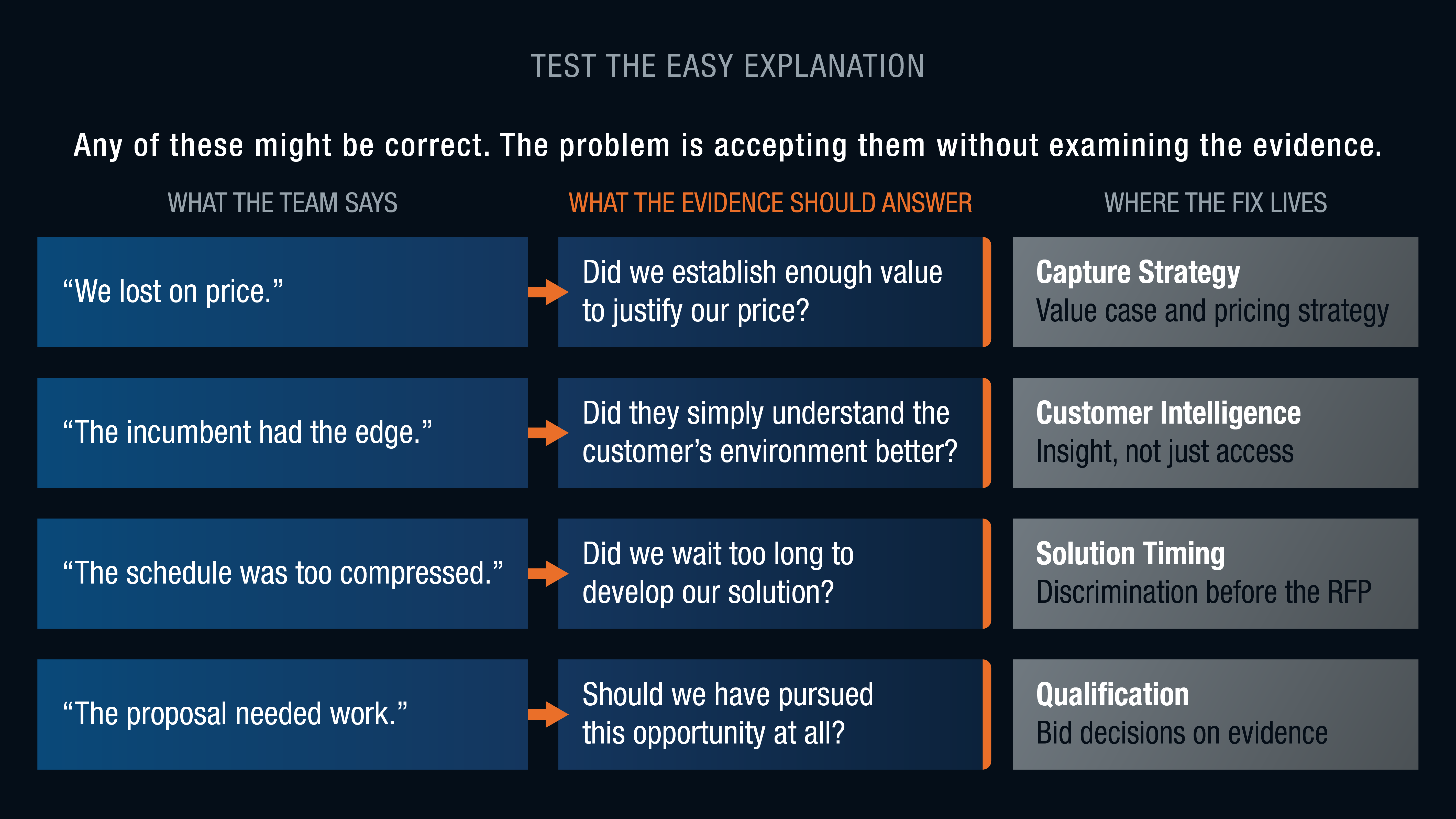
Any explanation might be correct. The problem is accepting it without examining the evidence.
Was price the deciding factor, or did the team fail to establish enough value to justify it? Did the incumbent win because of an inherent advantage, or because it understood the customer’s environment better? Was the schedule unreasonable, or did the organization wait too long to develop its solution?
These distinctions matter because they lead to different corrective actions.
A useful win-loss review separates the explanation that feels right from the explanation the evidence supports.
Start with the opportunities you should never have pursued.
Before analyzing how well your organization executed a pursuit, ask whether it should have pursued the opportunity at all.
Consider a familiar scenario. An attractive federal opportunity enters the pipeline. The contract value is significant, the work aligns with the company’s capabilities, and leadership wants to grow the account. The team proceeds despite limited customer access, an uncertain acquisition strategy, weak competitive positioning, or no clear understanding of how the customer will distinguish among bidders.
The proposal gets submitted. The team works hard. The company loses.
Leadership reviews the proposal and identifies improvements for next time. But what if the biggest mistake happened months before the proposal began?
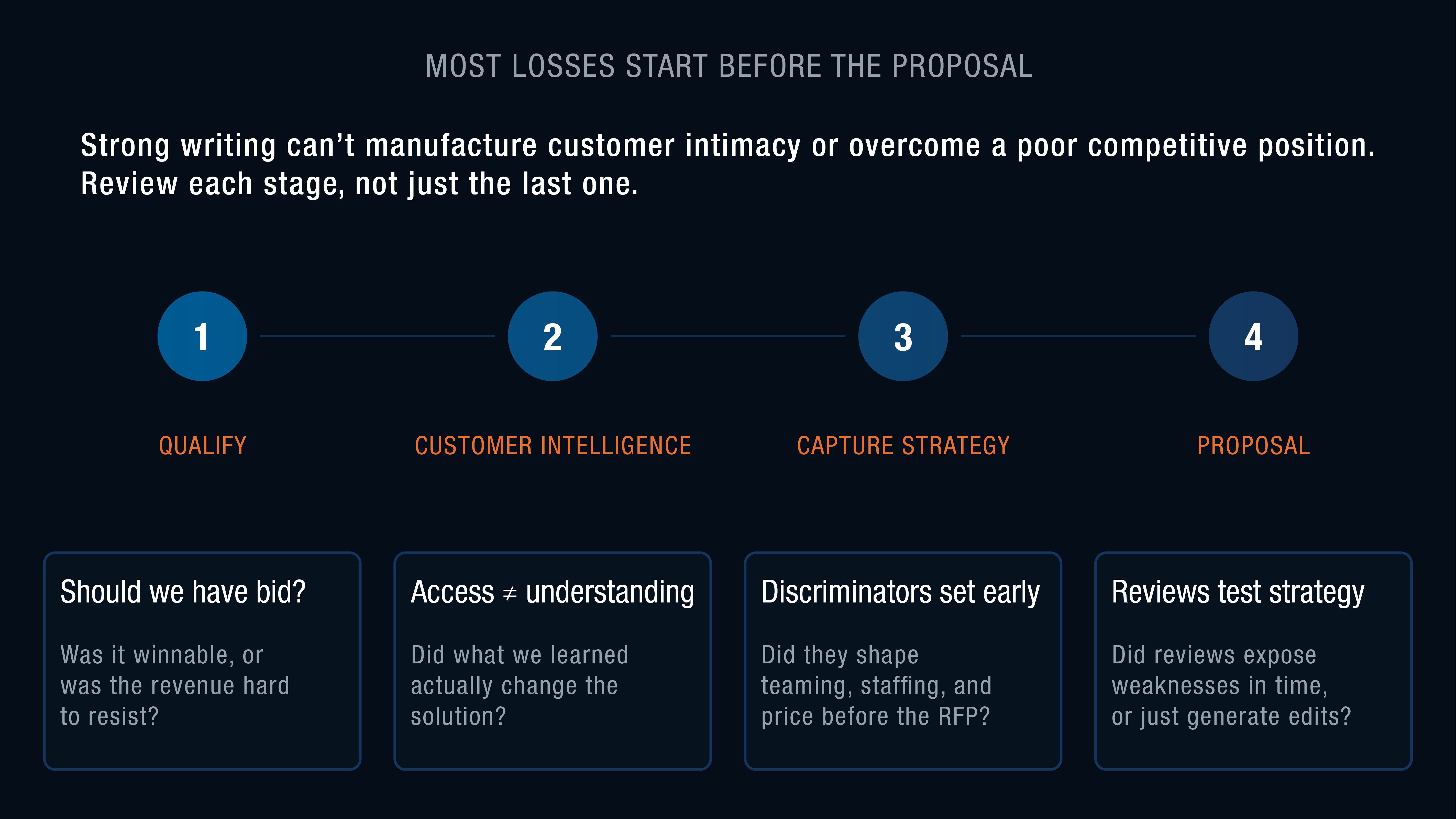
Strong writing cannot manufacture customer intimacy, create a differentiated solution overnight, or overcome a fundamentally poor competitive position. Yet organizations routinely invest in proposal execution when the underlying capture strategy hasn’t established a credible path to winning.
Look at FY2026 losses alongside the original qualification decisions. What did the organization know when it committed resources? Which risks were identified but ignored? Did leadership approve the pursuit because it was genuinely winnable or because the potential revenue was difficult to resist?
For FY2027, examine the quality of your pursuit decisions, not just your win rate. A smaller number of well-qualified opportunities may produce better results than a crowded pipeline that consumes resources without a credible path to award.
Sometimes the best lesson from a loss is that you shouldn’t have bid.
If FY2026 results suggest recurring issues across pursuits, Shipley’s Win Rate Diagnostic & Performance Benchmarking assesses proposals, capture practices, and BD pipeline discipline against benchmarks drawn from 400+ proposal assessments and 20+ years of data on high-performing organizations. The findings identify specific gaps and prioritize a path to close them. Replace the easy explanation with a diagnosis.
Customer access isn’t the same as customer understanding.
Regular customer meetings can create confidence without creating competitive advantage.
A team may have established relationships and understand the mission at a high level. Yet when the RFP arrives, its proposed solution looks remarkably similar to competitors’ offerings.
Why? Access creates an opportunity to learn. It doesn’t guarantee that learning occurs.
Effective capture means understanding the customer’s actual problem, desired outcomes, constraints, and likely evaluation priorities. It means using customer intelligence to shape a solution, not simply recording conversations and updating the call plan.
Suppose an agency wants to improve service delivery. Your team emphasizes staffing depth, certifications, and experience. Those qualifications may be necessary, but competitors can make similar claims.
What if the customer’s real concern is reducing service disruptions during transition? That insight could change your staffing model, transition plan, risk mitigation, and performance measures.
The difference isn’t better writing. It’s a better understanding of what matters.
When reviewing FY2026 pursuits, ask whether customer intelligence actually changed your solution. Identify assumptions that went untested and proposals that emphasized capabilities without connecting them to customer outcomes.
For FY2027, don’t just ask whether the team engaged the customer. Ask what it learned, what evidence supports those conclusions, and how that intelligence shaped the competitive strategy.
If your differentiators appear after the RFP, you’re already behind
Proposal teams are sometimes asked to do something extraordinarily difficult: develop a differentiated response under a compressed schedule when the competitive strategy is still taking shape.
The RFP arrives. Compliance requirements are mapped. Writing assignments are distributed. Pink and Red Team reviews are scheduled. Everyone is busy.
But activity isn’t evidence of competitive readiness.
If the team is still debating win themes during a major review, it may be discovering its strategy too late. If the technical solution simply mirrors the statement of work, compliance may be strong while differentiation remains weak. If the executive summary promises advantages the technical volumes don’t substantiate, the proposal tells an inconsistent story.
Capture establishes the competitive strategy; proposal management ensures that strategy becomes a coherent, evaluator-focused response.
Review your FY2026 submissions. Were discriminators established early enough to influence solution development, teaming, staffing, and pricing? Did reviews expose substantive weaknesses while there was time to correct them, or primarily generate edits and formatting comments?
For FY2027, treat proposal reviews as tests of competitive effectiveness, not just document quality. By a major review, the team should be able to demonstrate why its solution matters to the customer and how the proposal proves it.
Fix the cause, not just the symptom
Not every loss is preventable. Competitors may have stronger positions, customer requirements may change, and evaluation decisions may not align with expectations. Experienced leaders recognize those realities without using them to avoid examining their own performance.
The cost of a loss extends beyond the immediate pursuit: labor invested, resources diverted from other bids, forecast impacts, and lost customer momentum. When the same problems recur, those costs accumulate.
The answer isn’t an elaborate lessons-learned process that generates more documentation than improvement. It’s a short list of meaningful changes with clear ownership.
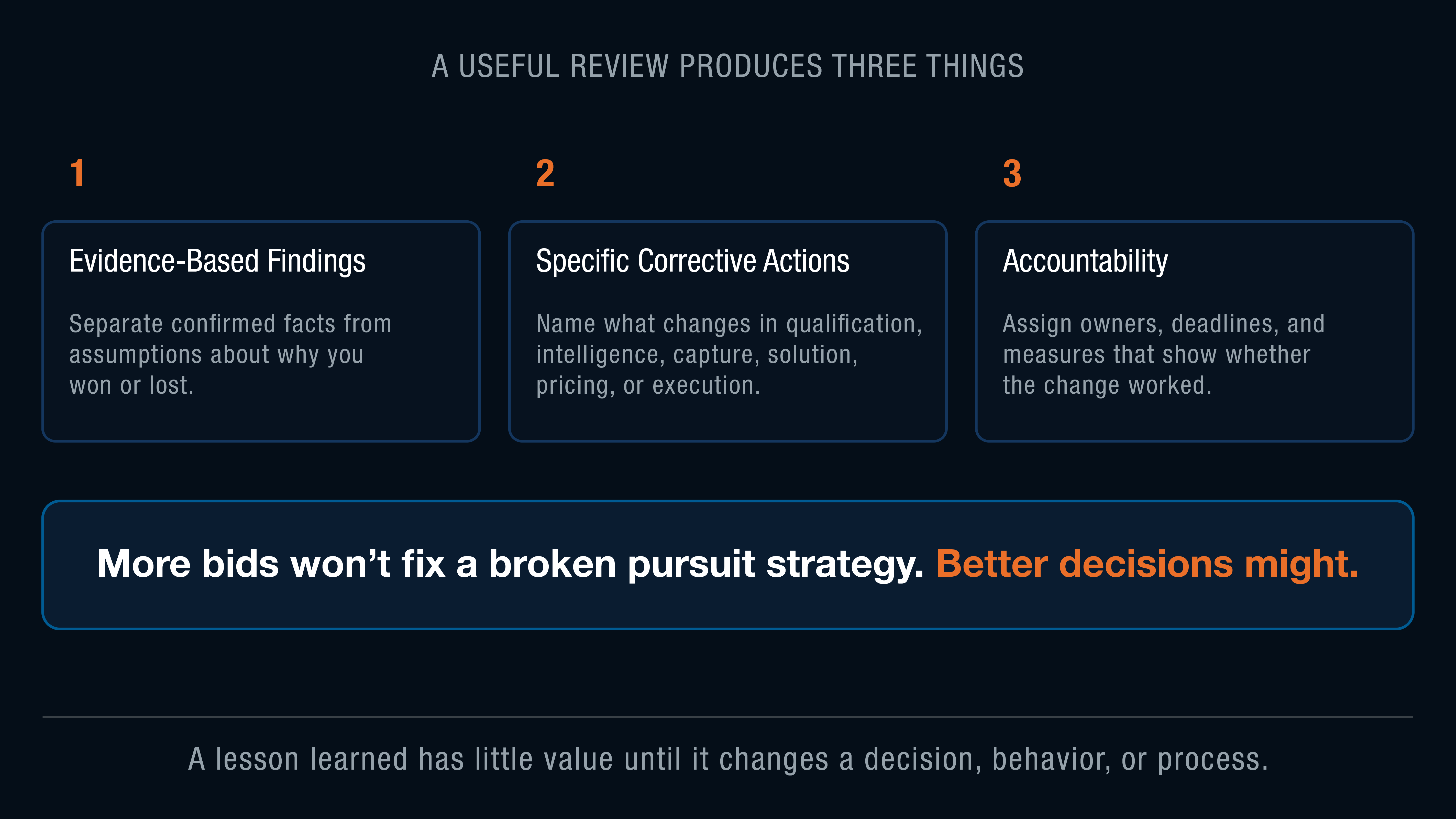
A practical FY2027 review should produce three things:
- Evidence-based findings: Separate confirmed facts from assumptions about why the team won or lost.
- Specific corrective actions: Identify what needs to change in qualification, customer intelligence, capture strategy, solution development, pricing, or proposal execution.
- Accountability: Assign owners, deadlines, and measures to determine whether changes improve performance.
If multiple pursuits suffered from late technical inputs, don’t simply remind subject-matter experts to respond sooner. Examine when they were engaged, whether responsibilities were clear, and whether leadership resolved competing priorities. Fix the conditions that caused the problem.
If teams repeatedly struggle to articulate meaningful discriminators, don’t just add another win-theme exercise to the kickoff agenda. Improve the customer intelligence and competitive analysis that should inform those themes.
A lesson learned has little value until it changes a decision, behavior, or process.
FY2027 should look different because FY2026 happened
For business development leaders, that may mean qualifying more rigorously and walking away from opportunities that don’t justify investment. For capture managers, it means challenging assumptions and building strategies around verified customer priorities. For proposal managers, it means engaging earlier and ensuring reviews test competitive effectiveness, not simply compliance. For executives, it means rewarding disciplined pursuit decisions rather than measuring growth solely by pipeline size or proposal volume.
These responsibilities are connected. Better proposals begin with better decisions. Better capture depends on better intelligence. Better business outcomes require leaders willing to act on the evidence.
As you review FY2026, resist focusing only on wins worth celebrating or losses that are easiest to explain. Look for the patterns that reveal how your organization actually competes.
Then choose what you’re going to change.
More bids won’t fix a broken pursuit strategy. Better decisions might.
And with the proper analysis, you can get better. At Shipley Associates, we help organizations strengthen the connection between business development, capture, and proposal execution through practical frameworks, training, and consulting. The goal isn’t simply to improve the next proposal. It’s to improve the decisions and behaviors that determine whether the next pursuit is worth pursuing – and whether your organization is prepared to win it.
Let us Help You Win
Whether you need training or consulting support to facilitate your next win, click one of the options below and let's get started.
