

Roles and Career Development in a Complex Bid Environment

Know the Roles. Build the Skills. Advance Your Career in Capture, Proposal, and Business Development.
Winning in complex bid environments requires more than effort. It requires a shared operating language, lifecycle discipline, and the credentialed expertise the market now demands.
In complex bid environments, winning requires more than a strong proposal or competitive price. It requires understanding customer needs, positioning capabilities early, and aligning resources across extended pursuit cycles. Business development is the discipline that makes this possible, yet it remains widely misunderstood, often conflated with sales, reduced to proposal activity, or treated as a narrow function. In reality, it is a system of interdependent roles with a single shared objective: winning work.
Business development spans market positioning, opportunity shaping, solution development, and formal proposal execution. Sales focuses on transactions. Proposals focus on responses. Capture focuses on one opportunity. Business development encompasses all of it. Success depends on engaging before a formal opportunity exists and aligning to how customers make decisions, at the right time, with the right message.
Core Leadership Roles in Winning Work
Three interdependent roles drive every complex pursuit. Each requires distinct expertise, and each represents a viable long-term career destination.
Business development does not depend on a single function. It relies on a coordinated system of roles, each contributing specialized expertise across the lifecycle. Their true effectiveness emerges from how they intersect, overlap, and reinforce one another over time.
A common misconception is that roles align neatly with specific phases. In practice, every role participates in multiple stages of the lifecycle, but with varying levels of engagement. Some roles carry strong influence early in the process and taper as execution becomes more structured. Others remain relatively quiet during initial positioning but become critical as the pursuit transitions into solution development and proposal execution. Responsibility does not shift from one role to another. It redistributes, expands, and contracts as the opportunity evolves.
One principle applies across all three roles: alignment to how the customer actually makes decisions. Every customer follows a process to identify needs, evaluate options, and select a partner, and key decisions are often made before formal evaluation begins. High-performing professionals, whether shaping pipeline, leading capture, or executing a proposal, treat pursuit as a coordinated effort to engage at the right time with the right message. Not all customers buy the same way, and professionals who develop this adaptive awareness consistently shape outcomes rather than simply execute them.
Business Development and Growth Leader
This role defines where and how the organization competes. Business Development and Growth Leaders align market opportunity, customer priorities, and internal capability to build a qualified pipeline. They operate earliest in the lifecycle, where strategic decisions carry the greatest long-term impact.
- Pipeline and Market Strategy: Identify and prioritize target markets, build customer and partner relationships, and align leadership on pipeline priorities to focus resources on the highest-value pursuits.
- Opportunity Qualification: Lead bid and no-bid decisions using structured criteria, evaluate competitive position, and confirm each pursuit reflects a credible path to win before resources are committed.
- Portfolio Alignment: Maintain coherence across simultaneous pursuits, balancing individual opportunity strategy with overall growth objectives and organizational capacity.
Capture Manager
Capture Managers define how the organization wins a specific opportunity. They translate identified opportunities into actionable strategies by shaping the solution, positioning the team, and aligning resources prior to formal bid. When capture is strong, proposal execution becomes disciplined. When it is weak, teams compensate under time pressure with limited ability to recover.
- Capture Planning and Win Strategy: Lead capture planning, develop the win strategy, and integrate inputs from business development, technical, pricing, and leadership teams into a cohesive approach.
- Customer and Competitive Engagement: Engage customers to validate needs and direction, assess competitor positioning, and refine strategy as the opportunity develops.
- Solution and Teaming Alignment: Align solution design, pricing, and teaming decisions to the win strategy, ensuring the organization enters the proposal phase with a credible and differentiated position.
Proposal Manager
Proposal Managers lead execution of the formal response, translating capture strategy into a compliant and compelling submission aligned to customer requirements and evaluation criteria. This is one of the most common entry points into business development. Career growth depends on expanding upstream into capture and planning to open pathways into broader leadership.
- Proposal Planning and Coordination: Develop and manage the proposal schedule, assign contributors across all volumes, and ensure the team is aligned to requirements and evaluation criteria from the outset.
- Compliance and Quality: Maintain compliance with all requirements, lead structured reviews, and ensure content reflects clear win themes and strong discriminators throughout the submission.
- Production and Submission: Oversee final production, document control, and on-time delivery, ensuring execution discipline translates into a high-quality response under compressed timelines.
Careers advance by moving upstream in the lifecycle. Expanding influence, not accumulating titles, is what defines progression in this field.
Entry Points, Career Pathways, and Core Skills
Careers advance by moving upstream in the lifecycle. Expanding influence, not accumulating titles, is what defines progression in this field.
Most professionals enter from adjacent roles: solutions architects and subject matter experts who bridge strategy and execution during capture; writers and volume leads who develop lifecycle perspective through planning and reviews; pricing professionals who expand into competitive positioning; and program managers who bring delivery insight into earlier lifecycle phases. The transition depends on one factor: moving upstream. Professionals who engage only during proposal phases limit their influence. Those who move into capture and planning shape outcomes.
Career Pathways
Career growth is not defined by a prescribed sequence of titles. It is defined by the expansion of responsibility, influence, and lifecycle awareness, from execution to strategy, from defined tasks to integrated leadership. The following framework reflects how professionals develop across five levels of increasing scope:
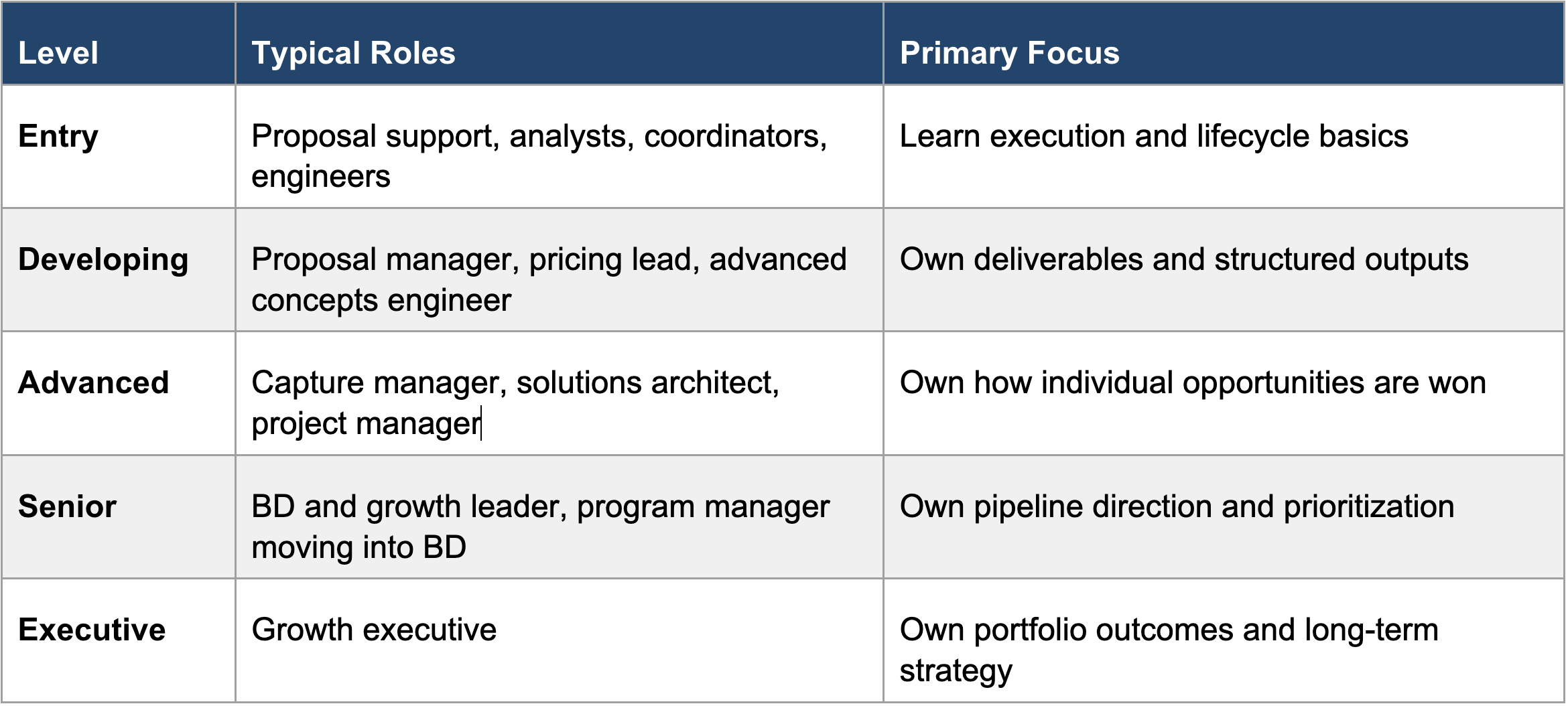
Progression is not linear. Many organizations depend on experienced proposal managers and capture leaders who choose to specialize. The goal is clarity on how each path develops and how individuals can increase their effectiveness within it. Shipley certification validates fluency across this full lifecycle, establishing the shared operating language, defined decision gates, and review discipline that the market recognizes and employers seek.
Core Skills
Success across all three core roles depends on four foundational capabilities. Each role applies these skills differently, but high-performing professionals develop strength across all four.
- Strategic Thinking. This skill defines how individuals evaluate opportunities and determine how to compete. Professionals assess viability using structured criteria, lead or support gate reviews, and translate capture strategy into a clear path to win. In proposal roles it shapes content around evaluation criteria. In capture it drives strategy. In business development and growth roles it governs portfolio-level prioritization.
- Customer Engagement. This skill reflects the ability to understand how customers make decisions and influence outcomes before formal evaluation begins. It requires building relationships that enable early access, understanding evaluation drivers, and aligning solution, messaging, and pricing to customer value. Each core role applies it differently, but none can succeed without it.
- Execution Discipline. This skill ensures strategy is translated into consistent, high-quality outputs through capture plans, proposal management frameworks, and color team reviews. Proposal managers depend on it under compressed timelines. Capture managers use it to keep plans actionable. Business development leaders rely on it for pipeline consistency.
- Communication and Leadership. This skill connects all others. Business development requires aligning cross-functional teams, communicating strategy clearly, and influencing decisions without direct authority. Early in a career it is applied through coordination. As professionals advance, it becomes the primary tool for organizational alignment and sustaining pursuit momentum.
Building and Accelerating Your Career
Deliberate exposure, early engagement, and cross-functional perspective separate those who execute from those who lead and win. Shipley certification is consistently cited as a preferred credential for capture, proposal, and growth leadership roles.
Every role in the business development system contributes to organizational performance, not just individual pursuit outcomes. When proposal managers execute with discipline, capture managers position with clarity, and business development leaders build qualified pipelines, the result is a team that competes consistently and wins at higher rates. Investing in your own capability within any of these roles directly strengthens the system as a whole. That connection between individual mastery and organizational performance is what makes professional development in this field worth pursuing deliberately.
For Individuals
Career progression begins with exposure and expands through deliberate engagement. Individuals who seek earlier involvement, build cross-functional relationships, and develop judgment through structured decision processes move more quickly from execution to influence.
- Get involved in proposal efforts early and often to build visibility into how organizations compete.
- Seek exposure to capture activities, including planning, strategy, and pre-proposal work, where future leaders develop perspective.
- Learn the customer's acquisition process to improve alignment of strategy, messaging, and execution.
- Engage in pipeline reviews and gate decisions to build judgment and influence over pursuit priorities.
- Move upstream over time, increasing involvement in earlier lifecycle phases where influence is greatest.
For Leaders
- Identify high-potential individuals in proposal, program, and technical roles early, before patterns become fixed.
- Assign individuals to capture efforts and planning sessions to build readiness for leadership roles.
- Involve emerging talent in gate decisions to develop the judgment required for business development and capture leadership.
- Rotate roles across lifecycle phases and align development to long-term organizational needs so future leaders are prepared at scale.
Careers in business development, capture, and proposal management are built through exposure, experience, and deliberate development. Individuals advance by moving upstream in the lifecycle and increasing their influence on decision-making. The objective is consistent across every role and every level: build the experience, judgment, and shared language required to win work in complex bid environments.
Shipley certification provides exactly that foundation. It validates fluency across the full pursuit lifecycle, from market positioning through post-award learning, and signals to hiring organizations that you operate within a proven, disciplined system. The field rewards those who engage early, align to how customers make decisions, and invest in credentialed expertise. Start by identifying where your involvement in the lifecycle can grow, and take deliberate steps to get there.
Let us Help You Win
Whether you need training or consulting support to facilitate your next win, click one of the options below and let's get started.
